
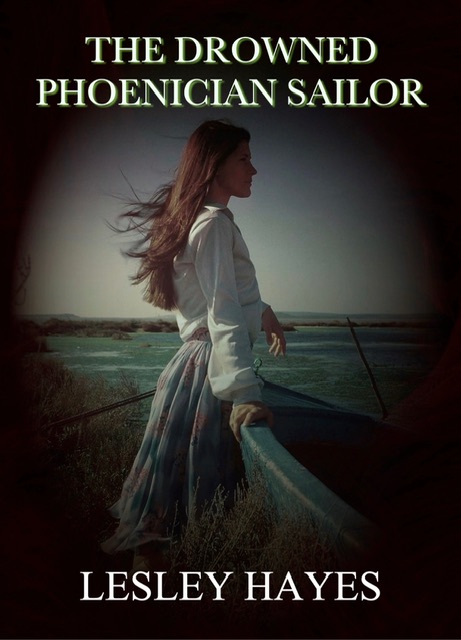
The Drowned Phoenician Sailor is the first book I published. Its title comes from a passage in ‘The Burial of the Dead’ in T.S. Eliot’s ‘The Wasteland’, and is a reference to the Tarot card the Ten of Swords, signifying the darkest hour before the dawn. This shows up in a Tarot reading early on in the novel. But the title came later, and wasn’t what inspired me to begin writing the story.
I could hear my muse calling – actually it was more of a shriek. The kind of shriek that wakes you up at night, wondering what on earth is happening – something really important although you can’t remember it. Adrenalin starts pumping, and your heart beats faster, and then your mind begins racing. It’s not the most comfortable of states, but it’s familiar enough now that I know what it means. Some alchemy has been at work in my psyche, and is desperately trying to push the results into my conscious mind.
I start noticing things in a different way, and making inspired connections. I get excited by certain concepts, playing a mental game of chess using characters who are gradually becoming real to me. And it was exactly this process that brought about the first draft of The Drowned Phoenician Sailor. I remember seeing two unrelated newspaper reports, each of which fired my imagination. Neither of them had anything to do with the story that evolved and ultimately became the finished book. But they set me thinking about assumed identities, deceit, the aftermath of grief, and what it might be like to have died with unfinished business.
I am intrigued by cause and effect, and the way that ripples spread out from seemingly random events, and I have been questioning what happens to individual consciousness after we die since I had my first attack of existential death anxiety at the age of four. These two elements combined to create the first creative glimmerings of my story.
I had no data about any of the characters when I began it, and they arrived on the page and wove their complicated dance of interaction with a logic that defied much intervention from me. I had an idea of where we were going, but wasn’t entirely sure what form the journey would take. But then it became clear to me that although I hadn’t set out to write anything remotely resembling a romance, the two main protagonists – Fynn and Jack – were destined to develop a relationship, despite Fynn’s reluctance and Jack’s denials.
The concept of destiny occurs in a number of my stories. Is life utterly meaningless, apart from the meaning we attach to it, or is there some larger and grander plot behind the scenes? I know I’m not the first writer to wrestle with this notion. An existential interpretation of Samuel Beckett’s ‘Waiting for Godot’ is a great example.
There was something immensely freeing for me as a psychotherapist to open the novel with the death of one. It was no coincidence that I began writing The Drowned Phoenician Sailor at the same time I made the decision to retire from practice. Paul, the psychotherapist whose death occurs in the first chapter, became in some ways my alter ego, released from the constraints of the role, no longer confined by boundaries and able to bring more of himself into his relationship with Fynn. He remains something of a mystery, and yet some might say he is as much a main player in the novel as either Fynn or Jack.
You as the reader will come to your own conclusions about whether or not he is objectively real in his ghostly form. The same applies to Fynn’s sister, whose regular visitations were the cause of Fynn seeking out a psychotherapist in the first place. If you believe there is a continuation of life after death then the ghosts in the novel will be satisfyingly plausible in their remarks and actions. If you take a more psychological viewpoint, there is an equally satisfying explanation about the powerful effect of grief. Does it matter? Perhaps it matters to you. But you won’t be disappointed, either way.
I had enormous fun with the characters in The Drowned Phoenician Sailor, and fell in love with Phoebe – Fynn’s mother – as soon as I started writing about her. Someone suggested that I write a sequel to the novel telling Phoebe’s story, and a number of years later I did exactly that in The Way Through the Woods. Someone else said they wanted to know what happened next to Fynn and Jack. But part of the point of a novel, I believe, is that you don’t see what lies beyond the edges of the picture, only the piece that exists within the frame. You are left to join up the dots with your own imagination and make the experience of reading the story your very own. It has touched you uniquely, in whatever way it has managed to do that. It speaks to you, in the end, with your own voice.
If you haven’t already read The Drowned Phoenician Sailor then perhaps this all seems rather incoherent to you. The best advice I can offer is that you try it for yourself.
You can find it on Amazon, on kindle and in paperback here https://mybook.to/DrownedSailor
And find out more about me and my books on my website https://www.lesleyhayes.co.uk
And continue to follow my blog at https://blog.lesleyhayes.co.uk